
AI Friendly Content Writing Guide for Modern Search
Welcome to the new standard of digital content creation. You are no longer writing only for human readers but also for AI powered search systems. When a user asks a question today, search engines often analyze multiple sources and generate a summary before showing traditional search results. If you want your website to contribute to those summaries, you should adapt your content strategy. Traditional SEO practices alone are no longer enough. AI systems prioritize clear structure, direct answers, and relevant information. You should write content that helps both people and AI understand your expertise.
The Direct Answer Sequencing Architecture
You should structure your information like a knowledge base. AI models use text segmentation to identify relevant answers quickly. If your main point appears too late in a section, another source may be selected instead.
Industry studies suggest that placing a direct answer near the beginning of a section improves the chances of appearing in AI generated summaries. Focus on clear answer sequencing throughout your content.
| Writing Strategy | How You Should Execute It | The Benefit |
|---|---|---|
| The Inverted Pyramid | State the exact factual answer in the first sentence of your section. Place the context and examples underneath it. | AI systems identify your core answer quickly. |
| Definitive Declarations | Start paragraphs with strong frameworks. Write sentences like The primary benefit is or The system works by doing this. | AI models can better recognize that your content answers the user's intent. |
| Question Targeting | Match your heading titles exactly to the questions users ask. Do not use clever or vague titles. | Search systems understand the relationship between the user's query and your heading more easily. |
| Information Density | Include a unique fact, statistic, or expert insight in every sentence. Remove unnecessary filler. | Rich information helps your content stand out from generic pages. |
Eliminating Synthetic Fluff & Passive Voice
Active voice improves clarity for both readers and AI systems. It clearly identifies the subject performing the action and makes content easier to understand.
-
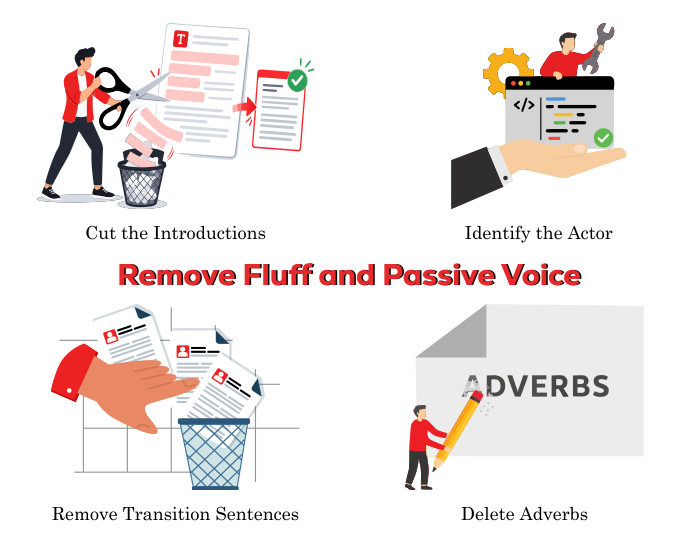
Cut the Introductions: Stop starting sentences with phrases like It is important to note that or As we all know. These phrases add little value.
-
Identify the Actor: Never write The code was updated. Instead write The developer updated the code. This clearly identifies who performed the action.
-
Remove Transition Sentences: Keep every paragraph focused on delivering useful information instead of unnecessary transitions.
-
Delete Adverbs: Words like very, highly, or extremely add little meaning. Replace them with measurable facts whenever possible. Instead of saying the software is highly effective, say the software increases processing speed by 40 percent.
Leveraging Expert Infrastructure for Scale
Applying these improvements across hundreds of existing web pages requires planning and consistency. Updating a few blog posts is not enough. You should improve the overall structure of your content management process. Working with professional artificial intelligence content optimization consulting services from Xcodefix helps improve the structure and accessibility of your content for AI powered search. We build content frameworks that help AI systems understand and retrieve your information more effectively.
Formatting for the Context Window
AI systems process well structured content more efficiently. Clear formatting helps organize information for both readers and search models.
Industry research suggests that comparison tables and structured lists help AI systems interpret information more efficiently than large blocks of text.
| Formatting Tool | The Rule for Maximum Extraction | Why It Helps |
|---|---|---|
| Bulleted Lists | Keep bullet points under 20 words each. Start every bullet point with an action verb or core entity. | Each point presents a clear piece of information. |
| Data Tables | Use simple two or three column tables with clear headings. | AI systems can compare structured information more easily. |
| Bold Text Anchors | Bold important entity names and key statistics. Avoid bolding entire sentences. | Important concepts become easier to identify. |
| Short Paragraphs | Limit paragraphs to three sentences and focus on one idea. | Smaller content blocks improve readability and content processing. |
The Content Length & Token Limit Reality
Longer content does not automatically perform better in AI powered search. Search systems process information in sections rather than as one continuous document.
-
The Chunking Principle: AI systems divide content into smaller semantic sections.Keep each section focused on a single topic.
-
Topic Isolation: Dedicate every section to one specific subject. Avoid mixing unrelated topics.
-
Pragmatic Length: Write only the information needed to answer the question completely. A focused 500 word article often performs better than a 2000 word article filled with unnecessary content.
-
Constant Refresh Rates: Updating specific facts and statistics regularly signals that your content remains current and relevant.
Optimize Your Content to Appear in AI Search Summaries
Appearing in artificial intelligence summaries depends on content structure as much as writing quality. Focus on creating clear knowledge blocks with direct answers, well organized tables, active voice, and concise sections. Every paragraph should provide useful information that supports the user's question.
As AI powered search continues to evolve, websites that prioritize clarity, structure, and factual accuracy will have a stronger chance of appearing in AI generated summaries. Partnering with an AEO Optimization Company like Xcodefix provides the technical foundation needed to improve content for modern search experiences. We build structured content that helps AI systems understand your expertise and improves your opportunities to appear in AI generated results.