
SEO Strategies That Still Work in 2026 for Better Results
SEO is not dead, regardless of what people have been saying on LinkedIn in all their posts when Google releases a new update. Instead, SEO has undergone some changes in a more subtle way. All those strategies which involved gaming the system, stuffing keywords, posting thousands of low-quality content, buying bulk backlinks – these strategies just do not work anymore. The fundamentals never left. They just got harder to fake.

Here's what's actually moving the needle this year, section by section, in whatever format makes each one easiest to actually use.
8 Proven SEO Strategies to Boost Search Rankings in 2026
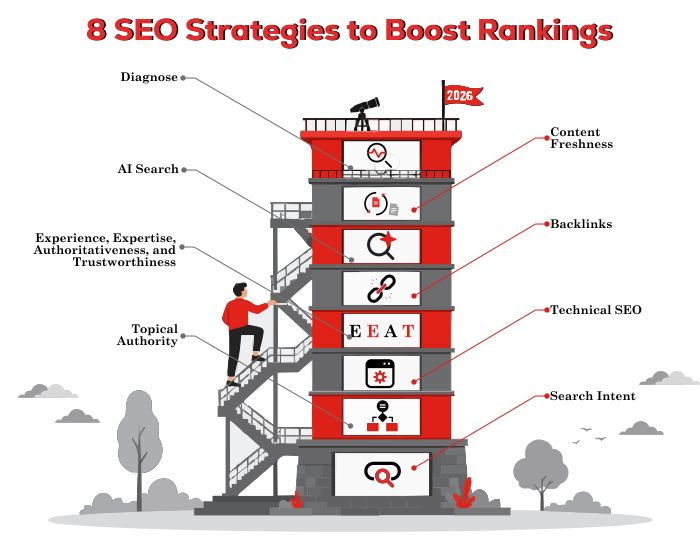
1. Search Intent Comes Before Keywords, Not After
Ranking for a keyword nobody meant to search for gets you traffic that bounces in four seconds. Google's whole system now weighs intent match heavier than exact keyword presence.
Before writing anything, ask what someone typing that query actually wants:
-
Are they trying to learn something, or ready to buy something?
-
Do they want a quick answer, or a deep breakdown?
-
Would a list satisfy them, or do they need a full walkthrough?
Match the format to the intent and the content mostly writes itself from there.
2. Topical Authority Beats Isolated Articles
One article about "email marketing tips" competing against a domain that's published forty deeply connected pieces on the same broader topic isn't really a competition. Google increasingly rewards sites that clearly know a subject inside out, not ones chasing single keywords in isolation.
A structure that still works:Build one pillar page covering a topic at a high level. Surround it with subtopic articles going deep on individual pieces of that topic. Link them together cleanly so both readers and crawlers can trace the whole cluster without hunting for it.
3. Technical SEO Is Still the Floor, Not the Ceiling
| Technical Factor | Why It Still Matters |
|---|---|
| Core Web Vitals | Slow, janky pages get demoted regardless of content quality |
| Mobile experience | Most search traffic is mobile, and Google indexes mobile-first |
| Crawlability | Content that bots can't reach might as well not exist |
| Structured data | Helps machines, including AI systems, understand what's on the page |
None of this replaces good content. But bad technical foundations will quietly cap how far good content can climb, no matter how well it's written.
4. E-E-A-T Is No Longer Optional Fine Print
Experience, expertise, authoritativeness, trust. Google's been talking about this framework for a while, but in 2026 it's become one of the clearest dividing lines between content that ranks and content that doesn't.
What actually demonstrates it in practice:-
Real author bios with genuine credentials, not a generic "written by the team"
-
Named sources instead of vague phrases like "studies show"
-
Original data or firsthand experience woven into the piece
-
Clear ownership, someone a reader could actually contact or verify
Anonymous, interchangeable content is exactly what AI-generated spam looks like from the outside. Standing apart from that now requires visible proof of a real person behind the work.
5. Backlinks Still Count, But Quality Has Gotten Ruthless
Buying links in bulk stopped working a long time ago, and Google's gotten sharper about spotting the pattern. What still moves rankings is earning links from sites that actually carry authority in your space.
How that actually happens:Create something worth linking to first, original research, a useful tool, data nobody else has published. Contact those sites directly with the asset instead of using some general pitch that you think might work. Guest blogging is effective if you actually have something valuable to offer beyond just another link drop.
6. Writing for AI Search in Addition to Organic Search
AI-powered search engines and chat-based search engines rely on the exact same high-quality content that would get organic rankings. It becomes increasingly more important to optimize for both as time goes on.
A few adjustments that help on both fronts:-
Answer the core question early, ideally within the first couple sentences under a heading
-
Use clear formatting, lists, tables, short paragraphs, since both readers and extraction algorithms favor it
-
Write subheadings as actual questions people would type or ask out loud
7. Content Freshness Signals Ongoing Relevance
A page published three years ago and never touched since starts losing ground even if the core information hasn't changed. Search engines read stale content as a weaker signal of current relevance, especially in fast-moving topics.
Quick freshness checklist:-
Update statistics and data points at least annually
-
Refresh examples so they don't feel dated
-
Check that internal links still point somewhere useful
-
Revisit formatting to match what's currently performing well
-
Add anything genuinely new that's emerged since the original publish date
8. Diagnose Before You Optimize
The strategy that's quietly working better than any individual tactic is treating SEO less like a checklist and more like a diagnosis. Instead of doing everything at once, find the actual bottleneck first.
Are qualified visitors not finding your site, or are they arriving and leaving without converting? The answer changes what you should actually be working on this quarter.
If visibility is the problem, invest in content and authority building. If traffic is fine but conversions aren't, the issue probably isn't SEO at all, it's what happens once someone lands on the page. One focused quarter addressing the real constraint tends to outperform six months of scattered, half-finished tactics.
Build a Stronger SEO Foundation With Xcodefix
Nothing here is a shortcut, and that is the point. At Xcodefix, we focus on the SEO fundamentals that continue to drive results in 2026: understanding search intent, building genuine authority, maintaining a strong technical foundation, and keeping content fresh. We help businesses turn these fundamentals into a practical SEO strategy that supports long term organic growth.