
How to Optimize Content for Voice Search & AI Results

Search behavior is changing fast. People no longer just type a few keywords into search engines. They now speak naturally to voice assistants, expect instant answers, and trust smart AI tools to guide them. This shift is not a small trend. It represents the level to which technology is merging into the routines. Voice searches are more like conversations, and on most occasions they are location-based. The searches with the help of AI are not about keywords. They understand the purpose, setting, and mood of each question. This change transforms how people find and view content. It brings a new challenge for SEO experts and companies that want to stay visible online. To stay ahead, your SEO strategy must follow the same direction as the users.
In order to remain at the top, your SEO strategy should be in the same direction as users move. It is not good enough to optimize based on short phrases or clicks on desktop computers any longer. Search engines have advanced to retrieve direct answers and summaries and fast facts with the use of complex AI models. Your content should be easy to understand and useful and should be well organized to a point where machines will interpret and give an immediate reaction. In this blog, you will learn how to prepare yourself and be ready for that change with future-proof and realistic SEO practices.
Understanding Voice Search & AI SEO for Smarter Ranking
The way users search is no longer based on short keywords. Voice and AI search focus more on how people speak and what they truly want to know. These searches are built around intent, context, and conversation.
Voice Search: Natural & Conversational
-
Voice searches sound more like real questions.
-
Instead of typing “best Thai food NYC ” ,a person might ask, “Where can I find good Thai food near me?”
-
These searches are longer, often use full sentences, and feel like a dialogue.
-
People expect clear and direct answers.
AI Search: Instant, Summary-Based Answers
-
AI tools like Google’s AI Overviews or Bing Copilot do not just show search results.
-
They gather short summaries, facts, and brand info and present the final answer immediately.
-
Users often get what they need without clicking any links.
Key Insight
Voice and AI tools are not just matching keywords.They are understanding intent and offering quick, direct solutions.
To stay visible, your content must:
-
Answer common questions clearly
-
Use a natural tone
-
Provide context that machines can understand
This is no longer about ranking on page one. It is about being the answer that voice assistants and AI tools choose first.
Key Differences Between Voice Search & AI SEO Explained
Voice and AI searches are based on a completely different process from conventional search. They are interested in how individuals converse, what they wish to find, and how quickly they prefer to receive the answer. A side-by-side explanation of how the two models vary is described below:
| Feature | Traditional SEO | Voice + AI Search |
|---|---|---|
| Input Method | Typed keywords | Spoken or conversational phrases |
| Query Style | Short, fragmented terms | Full questions or natural sentences |
| Result Format | List of 10 blue links | Direct answer, featured snippet, or AI-generated summary |
| Device Used | Desktop or mobile browser | Smart speakers, voice-enabled phones, AI assistants |
| Ranking Focus | Keyword match, backlinks, technical SEO | Relevance, search intent, natural language understanding |
| User Expectation | Explore and compare results | Get instant, accurate, voice-friendly answers |
| Content Value | Page-level optimization | Snippet-level clarity and contextual depth |
Why Voice & AI Search Matter for Modern SEO Strategy
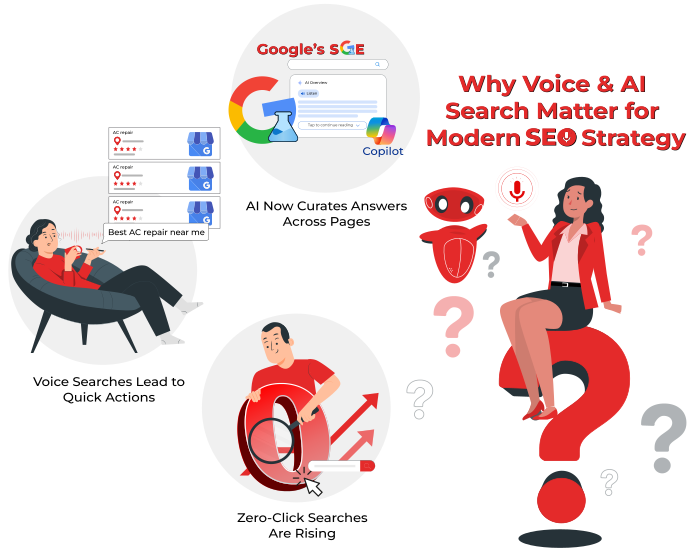
Voice and AI search are not just new features. They are a complete change in how users find and consume content. Here's why you need to shift your SEO strategy now:
Zero-Click Searches Are Rising
-
Users are getting answers without even clicking a website.
-
These answers often come from featured snippets or AI-generated summaries.
-
If your content is not structured to appear in these spots, you might lose visibility, even if you rank well.
Voice Searches Lead to Quick Actions
-
Many voice searches carry immediate intent. For example, “Best AC repair near me” usually means the user is ready to make a decision.
-
Being the top answer can bring instant leads or conversions.
AI Now Curates Answers Across Pages
-
AI tools like Google SGE and Bing’s AI Copilot pull content from multiple sources.
-
They focus on semantic meaning and topical relevance, not just keyword presence.
-
To stay visible, your content needs depth, clarity, and context that AI systems can understand.
How to Optimize for Voice & AI Search

This is where effective action meets clever SEO. These activities will make your content live and in focus on voice searches and AI searches.
Optimize for Questions & Natural Language
-
Use:
- “How do I apply for a home loan?”
- “What is the best time to visit Ooty?”
-
Write direct, clear answers right below each question.
-
Add FAQs on every main service or location page to help cover common spoken queries.
Focus on Long-Tail & Conversational Keywords
-
Use keyword tools like AnswerThePublic, People Also Ask, and Also Asked.
-
Identify how real users phrase their questions.
-
Example:
- Instead of “Car insurance Chennai”
- Use: “Which is the best car insurance plan in Chennai?”
-
These long-form keywords match how people speak to voice assistants.
Structure Content for Featured Snippets
Provide the answer early in the content, within the first few lines.
Use
- Bullet points
- Numbered steps
- Tables or definitions
-
Keep your language simple, direct, and easy to scan.
Improve Speed & Mobile Experience
Voice and AI prioritize fast, mobile-friendly sites.
Ensure: - Pages load under 3 seconds
- Responsive design across all devices
- Use of lazy loading and minified scripts
Add Schema Markup (Structured Data)
-
Use schema to help search engines understand the content type.
-
Key types: - FAQ
- How-To
- Product
- Local Business
- Review
-
Schema helps AI systems pull your content more accurately and visibly.
Role of AI in Content Discovery & Ranking
AI is not just changing how users search. It is also transforming how search engines read and rank content. Algorithms today no longer rely on matching keywords verbatim. They're more interested in the overall quality, composition, and relevance of your content.
How AI Models Like BERT & MUM Impact SEO & Ranking
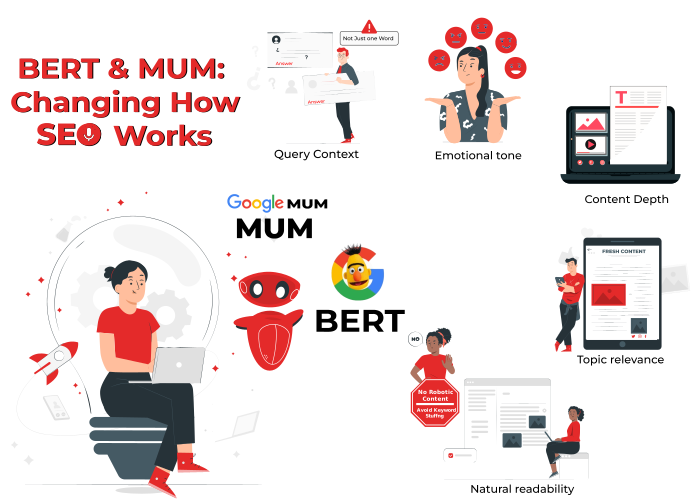
Search engines now use advanced AI models like BERT (Bidirectional Encoder Representations from Transformers) and MUM (Multitask Unified Model). These models help search engines understand content with human-like accuracy.
Here’s what they evaluate:
-
Query context: They look at the full meaning behind a query, not just individual words. This helps match your content with the user’s real intent.
-
Emotional tone: AI can sense tone and decide if your content feels helpful, informative, or misleading.
-
Content depth: Pages that give shallow answers get passed over. Depth shows authority and trustworthiness.
-
Topic relevance: Content must stay focused and cover what the user actually wants to know, without drifting off-topic.
-
Natural readability: AI prefers writing that is clear, direct, and easy to follow. It avoids content that sounds robotic or stuffed with keywords.
What This Means for SEO
To rank well in AI-driven search, your content must do more than check boxes. It must communicate clearly, solve real user problems, and be easy for both people and machines to understand.
Focus on creating content that
-
Solves real problems: Address genuine user needs with accurate and useful solutions.
-
Covers topics fully: Do not stop at surface level. Include explanations, examples, and related details that show you know the topic inside and out.
-
Reads naturally: Avoid overusing keywords. Write the way people speak and search.
This holistic content helps AI engines understand and prioritize your page.
Voice & AI SEO for Local Businesses
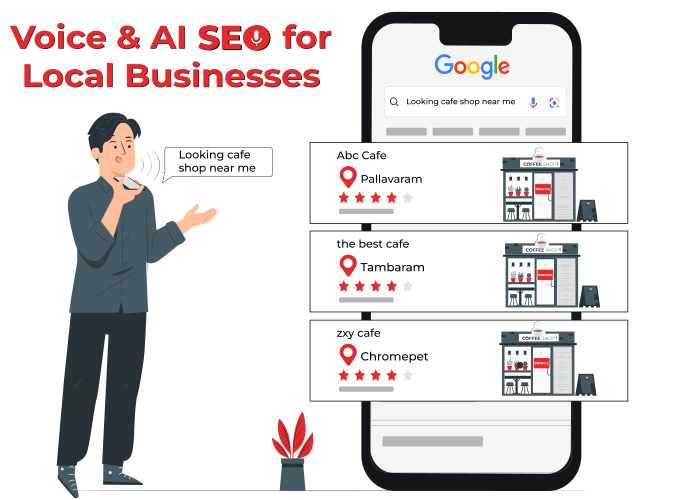
Small local business owners are those who can use voice and AI search the most, provided that they appear on the top when people form location-oriented queries.
Key Actions for Local SEO Readiness
-
Claim and fully optimize your Google Business Profile
-
Add location-based phrases naturally:
- “Affordable electrician in Erode”
- “AC repair near Anna Nagar”
Include location-focused FAQs
- “What is the best plumbing service in Pondicherry?”
Keep your
- Phone number
- Opening hours
- Services
- Map location up-to-date and consistent everywhere
Why This Matters
-
Voice searches often have strong local intent.
-
Being present with correct info helps AI assistants suggest your business first.
Measuring Success: What to Track
Success in voice and AI search is not always visible through classic rankings. You need to track new types of performance metrics.
Metrics That Matter Now:-
Featured snippet placements
-
People Also Ask appearances.
-
Search Console's “search appearance” data.
-
Long-tail impression growth (from voice-style queries).
-
Branded and question keyword tracking.
Traditional keyword rankings alone won’t show how well you perform in AI-driven results. These new metrics reflect real visibility.
Preparing for the Future: What’s Next
Search will continue to evolve with new technology. SEO strategies must be ready for what’s already arriving.
Emerging Trends to Watch
-
Multimodal Search: Users can search using images, text, and voice together, especially with tools like Google Lens.
-
Hyper-Personalized AI Results: AI systems may start customizing answers based on your past activity, preferences, and behavior.
-
Rise of First-Party Data: Reviews, original content, and user engagement on your site will start to outweigh backlinks.
How to Future-Proof Your SEO
-
Keep your content fresh, useful, and user-first
-
Build a recognizable brand voice across content formats
-
Invest in tools that track AI visibility, discover conversational keywords, and improve topical coverage
Future of SEO is Voice AI & Smart Content with Xcodefix
Voice and AI search are not just trends. They mark a big change in how people use the internet. Search engine optimization is changing fast because voice search and AI tools now understand human behavior, intent, and context. Today, your content must give real value, answer real questions, and match how people speak and search in everyday language. This is the key to success in AI-powered search.
It is no longer just about search rankings. It’s about becoming the most relevant and trustworthy source of information across voice-enabled platforms and AI-powered discovery tools. That is where the right SEO partner makes all the difference in this dynamic landscape.
With over 15 years of experience, Xcodefix has consistently adapted to major algorithm shifts from mobile-first indexing to semantic search and now the future of SEO powered by AI. Our strategies are data-driven, user-behavior focused, and built for the future. If you’re searching for the best SEO company that understands both the roots and the next evolution of search, including voice and AI search optimization, Xcodefix is engineered for it.