
How AI Search Engines Rank Content in Search Results
Welcome to the new era of search. We no longer optimize only for traditional search engines. Today, we also optimize for AI powered answer engines. The way content becomes visible has changed significantly.
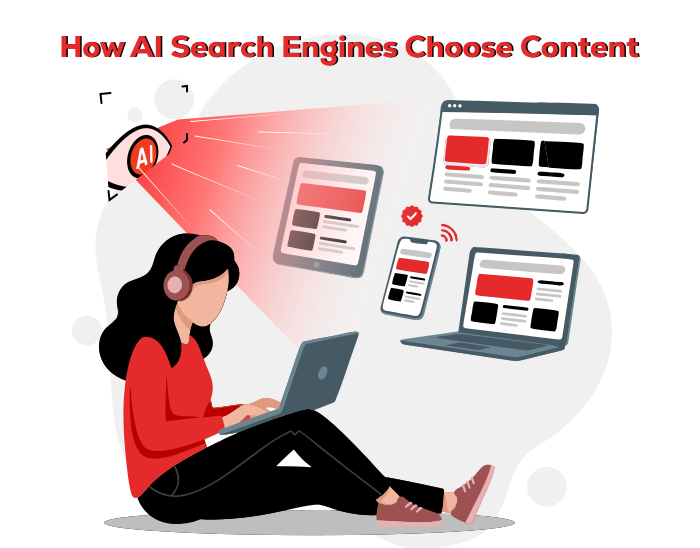
While old search engines were mostly index-based, modern AI search engines place much more emphasis on the meaning, context, and intent of the users. The search is not limited to keywords anymore; it employs semantic technology to find the most relevant content.
Keyword stuffing doesn't have an impact on rankings anymore. Your website will rank well if its content can be understood by AI as answering users' queries adequately and accurately enough. This requires a different strategy in content creation and organization.
How AI Search Uses Vector Embeddings to Rank Content
What is the language of AI and how do AI search engines understand text? AI represents texts as mathematical models called vector embeddings and processes these representations to understand the semantic meaning of what is written and to understand the relationships between different concepts.
| Algorithmic Concept | How the Engine Processes It | Why It Matters |
|---|---|---|
| Vector Embeddings | AI converts words and phrases into numerical vectors within a semantic space. | Related terms such as "sneakers" and "running shoes" are represented closely, allowing AI to understand their relationship without relying on exact wording. |
| Cosine Similarity | The system measures how closely the user's query matches your content mathematically. | Pages that closely match user intent are generally more likely to be retrieved and cited. |
| Contextual Weight | AI assigns meaning to words based on surrounding context. | Using accurate terminology and complete explanations helps AI understand your expertise. |
| Organic Search Foundation | AI systems often retrieve information from pages that already perform well in traditional search. | Strong technical SEO and quality content improve the chances of AI discovery. |
| Semantic Completeness | AI evaluates how thoroughly a topic is covered. | Comprehensive pages that answer related questions are more likely to be referenced. |
How Retrieval Augmented Generation Supports AI Search Rankings
Many AI search platforms, including Perplexity and Google AI Overviews, use a process called Retrieval Augmented Generation (RAG). This workflow helps AI retrieve reliable information before generating a response.
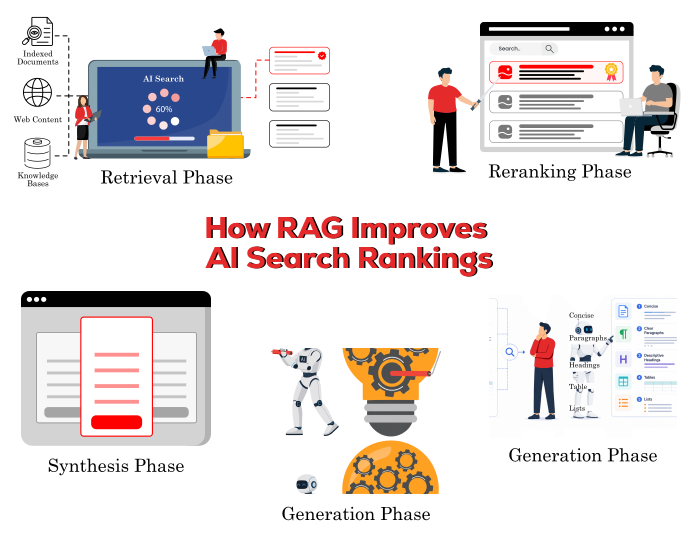
Retrieval Phase
The AI searches millions of indexed documents and vector embeddings to find content that closely matches the user's query. Well structured pages with clear headings and logical organization improve retrieval.
Reranking Phase
The system evaluates candidate pages based on relevance, accuracy, context, and content quality before selecting the strongest passages.
Synthesis Phase
Relevant facts, statistics, and supporting information are combined from multiple trusted sources.
Generation Phase
The AI generates a response using the most relevant information and may cite the sources that contributed to the answer.
Best Practice
Write concise sections that answer one topic completely. Clear paragraphs, descriptive headings, tables, and lists make it easier for AI systems to retrieve and understand your content.
How Information Gain Improves AI Search Visibility
Google's research and patents around Information Gain suggest that search systems may reward content that introduces unique and valuable information rather than repeating existing content.
To improve information gain:-
Publish original research and data.
-
Share industry surveys and proprietary findings.
-
Include real case studies and measurable results.
-
Add expert insights and interviews.
-
Create original charts, tables, and visual assets.
-
Update content with new developments and current information.
Content that contributes new knowledge is more likely to stand out in both traditional and AI powered search.
How Entity Resolution Builds Trust in AI Search
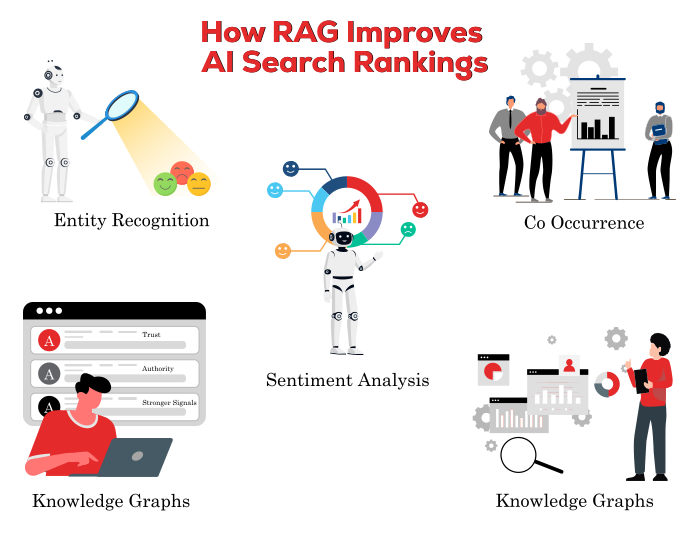
Modern AI search systems evaluate entities as well as web pages. An entity may represent a business, product, person, or organization.
-
Entity Recognition: AI identifies your business, products, and authors as distinct entities.
-
Co Occurrence: Your brand consistently appears alongside relevant industry topics.
-
Sentiment Analysis: AI evaluates how your brand is discussed across trusted sources.
-
Unlinked Brand Mentions: Trusted mentions without hyperlinks can strengthen your brand's entity signals.
-
Knowledge Graphs: Consistent information across the web helps AI build confidence in your business.
Building strong entity signals improves trust and increases the likelihood of being surfaced in AI generated answers.
Enterprise Generative Engine Optimization Strategies for AI Search
Scaling AI visibility across hundreds or thousands of pages requires more than basic SEO. Enterprise Generative Engine Optimization focuses on making websites easier for AI systems to understand, retrieve, and cite.
-
Audit your content architecture and organize information into clear question and answer sections.
-
Implement structured data where appropriate.
-
Improve internal linking and semantic relationships between pages.
-
Present important information using tables, bullet lists, and concise paragraphs.
-
Write in clear, active language.
-
Improve page speed and technical performance.
-
Keep important pages crawlable and accessible to AI search crawlers.
These practices help AI systems interpret your content more efficiently while supporting both traditional SEO and AI search visibility.
Why Generative Engine Optimization Matters for AI Search
AI powered search is changing how users discover information online. Success now depends on creating content that is accurate, well structured, trustworthy, and easy for AI systems to understand.
Generative Engine Optimization combines traditional SEO with semantic search, entity optimization, structured content, and AI friendly information architecture. Businesses that invest in these strategies are better positioned to improve visibility across ChatGPT, Perplexity, Google AI Overviews, and other AI powered search platforms.
Improve AI Search Visibility with Xcodefix
Xcodefix helps businesses strengthen their online presence through Generative Engine Optimization, AI Search Optimization, ChatGPT SEO, Perplexity SEO, LLM SEO, and AI Visibility strategies. We optimize website architecture, improve topical authority, create citation worthy content, and strengthen entity signals so AI search platforms can better understand and surface your business.
Contact Xcodefix to build a strategic AI SEO and Generative Engine Optimization strategy that improves your visibility across today's leading AI search platforms.