
The GEO Revolution: Optimize Content for Perplexity AI Citation
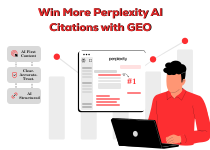
In the landscape of modern search, the goalpost has shifted permanently. For years, the digital marketing world has been obsessed with "blue links"—the holy grail of ranking on page one of traditional search engines. But today, the game is no longer about just getting a link; it is about becoming the primary source for AI-generated answers. This is the era of Generative Engine Optimization (GEO).
Perplexity AI, along with similar answer engines, doesn’t just index web pages; it synthesizes information from them to provide direct, concise responses to user queries. To thrive in this environment, your content must be readable, reliable, and perfectly structured for an AI retrieval pipeline. If you want to earn the coveted "citation" from Perplexity, here is your essential playbook for 2026.
Ensure Your Site is AI-Accessible
Before you worry about tone or keyword density, you must ensure your technical foundation is open to AI crawlers. Many sites inadvertently block these bots through restrictive robots.txt configurations.
To be cited, your content must be discoverable. Check your robots.txt file to ensure PerplexityBot is explicitly allowed to crawl your domain. Furthermore, prioritize server-side rendering. Modern AI crawlers often struggle with heavy JavaScript frameworks. In case the information that is crucial for you like your definitions or product descriptions becomes available to users after their interaction with the website, then it may not be seen by the AI. Always ensure that your site is fast and clean.
The Power of BLUF: Bottom Line Up Front
Perplexity’s reranking algorithms are designed to extract "truth nuggets" as efficiently as possible. They favor content that gets straight to the point. The most effective way to communicate with an AI is the "Bottom Line Up Front" (BLUF) method.
After every H2 heading, provide a direct, concise answer to the implied question. Aim for a 40–100 word summary that encapsulates the core value of that section. Think of this as the "featured snippet" on steroids. By providing a clear, accurate summary at the top of every section, you make the AI’s job easier, which significantly increases the likelihood that it will pull your content as its definitive source.
Use Semantic Formatting to Signal Authority
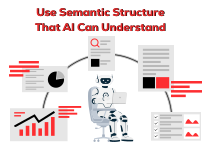
AI models are trained to prioritize information that is highly structured. When the AI scans your page, it looks for "high-confidence" elements that denote factual data.
Avoid writing massive, wall-of-text paragraphs. Instead, lean heavily into semantic formatting
-
Lists: Use ul and ol tags for how-to steps or feature lists.
-
Tables: Use table tags for comparative data. AI models love tables because they provide clean, row-by-column relationships between variables.
-
Bold Keywords: Use bolding judiciously to highlight key concepts.
By breaking your content into these segments, you provide the AI with a logical structure that it can easily "map" to the user’s query.
Build Authority Through Provenance
Perplexity prioritizes trustworthiness above all else. In a world filled with AI-written content, the tool needs proof that an actual expert human has written your work.
All works must have an identified author, along with a biography linking to credible sources such as their LinkedIn or author profile. Moreover, you must always credit your primary sources. If you make a claim, link to the original study or data set. When you cite a reputable source, you are effectively "loaning" your content some of that source's credibility.
Aggressive Freshness & Temporal Signals
Perplexity exhibits a strong "recency bias." It favors information that is accurate at the moment of the query.
Use the "60-day loop" approach for pillar content. Twice a year, check your high-performing content for accuracy. It is not only about updating the content but making sure the metadata is updated as well. Make sure that you have an up-to-date dateModified schema and the date mentioned is visible on the website. Using such phrases as "As of June 2026..." is quite straightforward and effective.
Target Concepts, Not Keywords
Finally, shift your mindset from "keywords" to "semantic concepts." Instead of writing one giant page trying to rank for a single term, build topical clusters.
Create a comprehensive "pillar" page that covers the broad topic, then surround it with 8–12 related, deep-dive cluster pages that answer specific sub-questions. This interlinking signals deep topical authority. When the AI sees that your site is the hub for a specific concept, backed by hard metrics, original statistics, and clear, structured answers, it becomes the natural choice for the engine to cite.
Master Generative Engine Optimization With Xcodefix
Generative Engine Optimization isn't about gaming a system; it’s about being the most useful source on the internet. The way to get cited is through the careful crafting of your content to make it easy for AI to extract the truth from it, without thinking too much about it. By 2026, the winners will be the companies that deliver the greatest value, clarity, and most accurate data. It takes finesse to succeed in GEO. If you are ready to stop chasing blue links and start dominating AI-generated answers, Xcodefix is here to help. We specialize in high-level GEO services designed to optimize your content architecture for Perplexity, Gemini, and beyond. Let our team handle the technical heavy lifting, from schema implementation to semantic cluster strategy, so you can focus on building your brand.
Start building your authority today; contact Xcodefix- The Best SEO Agency and let us ensure your content is the one the AI chooses to cite.